Gas compressors play a critical role in applications where controlled gas pressure is essential. Whether it is natural gas pipelines or air compression in industrial machinery, compressors ensure smooth and reliable operations.
How Gas Compressors Work
Gas compressors operate based on thermodynamic principles. The main goal is to reduce gas volume while increasing pressure. This is achieved through mechanical work applied via different compression mechanisms.
The general working process includes:
- Intake of gas at low pressure
- Compression through mechanical action
- Discharge of gas at higher pressure
Depending on the design, compressors may use pistons, rotating impellers, or screws to achieve compression. The process may involve single-stage or multi-stage compression depending on the required pressure level.
Importance of Gas Compressors in Industry
Gas compressors are essential for maintaining operational efficiency in many sectors. They solve key challenges related to gas handling, pressure control, and energy utilization.
Their importance includes:
- Enabling long-distance gas transportation in pipelines
- Supporting industrial automation systems
- Assisting in refrigeration and HVAC systems
- Enhancing efficiency in chemical processing
- Providing compressed air for manufacturing operations
Without compressors, many industrial processes would be inefficient or impractical.
Types of Gas Compressors
Gas compressors are categorized based on their working mechanism and application.
Reciprocating Compressors
These use pistons driven by a crankshaft to compress gas.
They are suitable for high-pressure applications and are commonly used in oil and gas industries.
These use two rotating screws to compress gas.
They are efficient, continuous, and widely used in industrial settings.
Centrifugal Compressors
These rely on high-speed rotating impellers to increase gas velocity and convert it into pressure.
They are ideal for large-scale operations.
Used mainly in power plants and aviation, these compressors handle large volumes of gas with relatively low pressure increases per stage.
Key Components of Gas Compressors
Essential Parts
- Compressor housing
- Pistons or rotors
- Valves and seals
- Cooling system
- Lubrication system
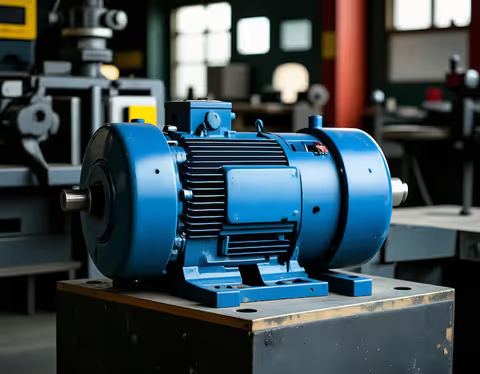
- Drive motor
Each component contributes to efficient compression and system reliability.
Features of Modern Gas Compressors
Advanced Capabilities
- Energy-efficient designs
- Smart monitoring systems with sensors
- Automated pressure control
- Reduced noise and vibration
- Compact and modular structures
Modern compressors are designed to optimize performance while minimizing energy consumption and maintenance needs.
Applications of Gas Compressors
Industrial and Commercial Uses
- Natural gas processing and transport
- Refrigeration and air conditioning systems
- Power plants and energy generation
- Manufacturing and automation systems
- Petrochemical and chemical industries
Gas compressors are foundational in industries that rely on pressurized gas systems.
Table: Comparison of Gas Compressor Types
| Type | Working Principle | Best For | Efficiency Level |
|---|---|---|---|
| Reciprocating | Piston-based compression | High-pressure applications | High |
| Rotary Screw | Twin rotating screws | Continuous industrial use | Very High |
| Centrifugal | Impeller-based | Large-scale operations | Moderate-High |
| Axial | Airflow compression | Power and aviation systems | High |
Recent Trends and Developments (2025–2026)
The gas compressor industry has seen significant advancements in the past year, driven by energy efficiency goals and digital transformation.
Key developments include:
- Integration of IoT-enabled monitoring systems (2025)
- Adoption of AI-based predictive maintenance tools (2025–2026)
- Development of oil-free compressors for cleaner operations (2025)
- Increased use of hydrogen compression technology (2026)
- Focus on low-emission and environmentally friendly systems
These innovations are helping industries reduce energy consumption and improve operational reliability.
Regulations and Compliance
Gas compressors must adhere to various international and regional standards to ensure safety and efficiency.
Important regulations include:
- ISO standards for compressor performance and safety
- Environmental regulations for emissions and noise control
- Industry-specific compliance in oil, gas, and chemical sectors
- Workplace safety standards for equipment operation
Compliance ensures safe operation and minimizes environmental impact.
Tools and Learning Resources
Useful Platforms and Resources
- Engineering simulation software for compressor design
- Industrial automation platforms for monitoring systems
- Technical courses on thermodynamics and fluid mechanics
- Industry publications and research journals
- Manufacturer documentation and training materials
These resources help professionals understand and optimize compressor systems.
Common Challenges and Solutions
Gas compressors face operational challenges that require proper management.
Key Challenges
- Energy consumption
- Heat generation during compression
- Wear and tear of components
- Leakage and pressure loss
Practical Solutions
- Regular maintenance and inspection
- Use of advanced cooling systems
- Adoption of energy-efficient models
- Implementation of monitoring technologies
Addressing these challenges improves system longevity and performance.
FAQs
What is the main function of a gas compressor?
A gas compressor increases the pressure of gas by reducing its volume, enabling efficient storage and transport.
Which industries use gas compressors the most?
Industries such as oil and gas, manufacturing, refrigeration, and power generation rely heavily on compressors.
What is the difference between rotary and reciprocating compressors?
Rotary compressors provide continuous operation, while reciprocating compressors are better suited for high-pressure applications.
Why is cooling important in gas compressors?
Compression generates heat, and cooling systems prevent overheating, ensuring safe and efficient operation.
Are modern gas compressors energy efficient?
Yes, recent models include energy-saving technologies and smart monitoring systems to improve efficiency.
Conclusion
Gas compressors are vital components in modern industrial systems, enabling efficient gas handling across multiple sectors. Their ability to increase pressure and support complex processes makes them indispensable in applications ranging from energy production to manufacturing.
With advancements in technology such as smart monitoring, energy-efficient designs, and environmentally friendly systems, gas compressors continue to evolve. Understanding their working principles, types, and applications helps industries optimize performance and adapt to changing technological and regulatory landscapes.